
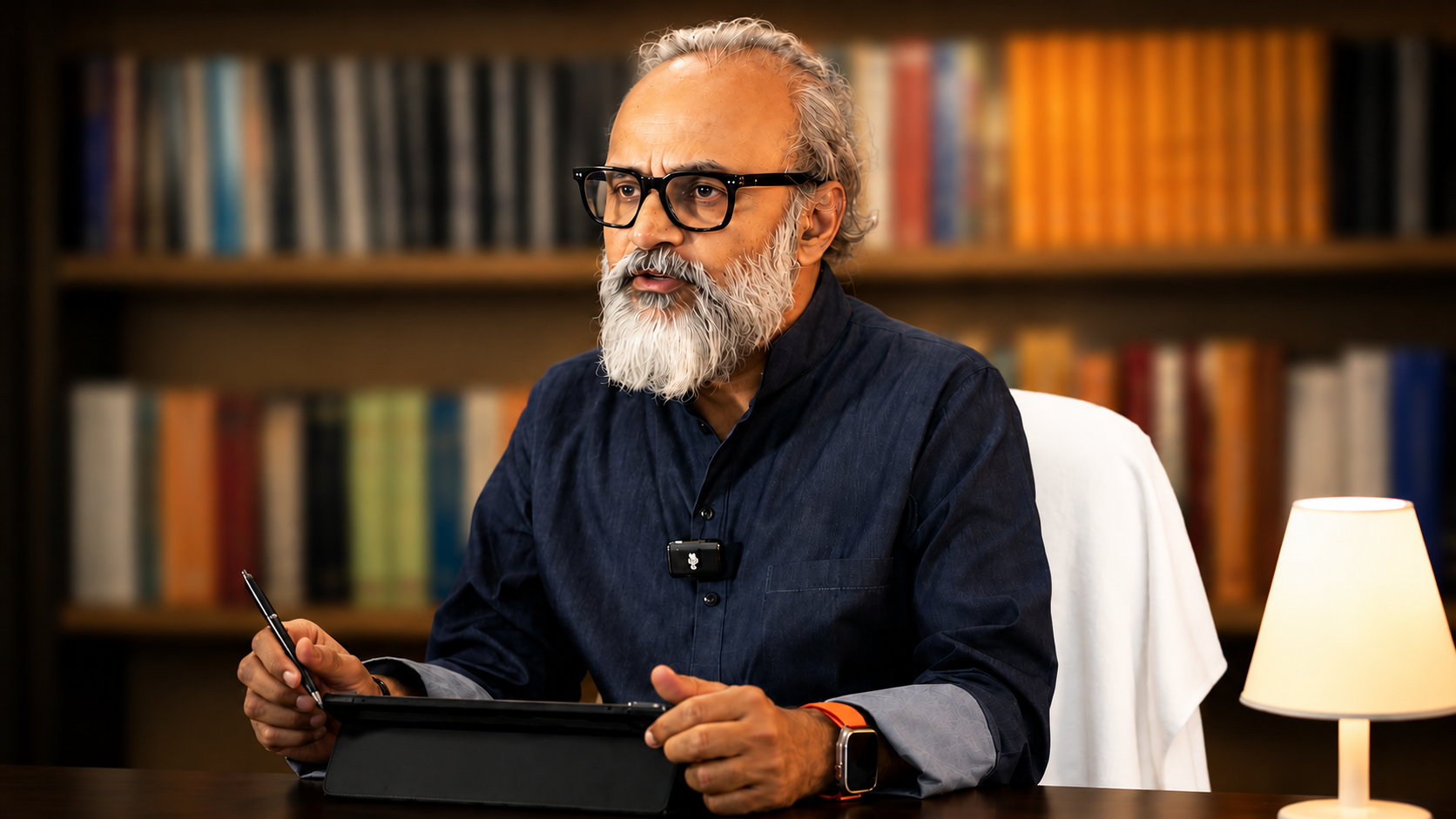
True Direction of Deep Chest Breathing
3 months ago By Yogi AnoopNot Breath, but Perception — The True Direction of Deep Chest Breathing
Whenever “deep chest breathing” is mentioned, the ordinary mind—the layman’s understanding—instantly translates it into taking long, deep, expanded breaths. For most, pranayama becomes a repetitive formula: inhale deeply, extend the breath, hold it, and then release. Whether it is Anulom-Vilom, Ujjayi, Bhramari, Sheetali, or any other technique—the same mechanical pattern tends to repeat itself.
Naturally, a question arises: if every practice appears to follow the same method, why were they given different names at all?
It is here that a subtle yet profoundly important dimension of understanding is missed. The ancient seers were not merely pointing toward the length, depth, or retention of breath. Their indication was toward an inner awareness—an awakening that unfolds through breath, but not limited to it—reaching into the subtler layers of body and mind.
When we speak of “deep chest breathing,” it does not simply mean filling the chest with a long inhalation and emptying it out again. Its essence lies elsewhere: the mind must rest upon those regions and muscles through which the breath is actually moving. The focus is not on the breath itself, but on the chest, the ribs, the upper back—on observing, with sensitivity, which muscular structures are participating in the process of breathing.
The priority, then, shifts—from breath to experience. From air to awareness.
One begins to feel the expansion of the chest… the subtle opening… and then its quiet return, its soft contraction. The experience of movement—expansion and relaxation—becomes central.
If we observe closely, this understanding is not entirely new to us. When we run, for instance, the breath naturally becomes rapid. Yet, our attention is not on the breath—it is on the movement of the chest: how it rises and falls, how pressure builds and releases. Similarly, in Bhastrika, what we truly perceive is not the breath itself, but the forceful expansion and compression of the chest. Breath is merely the consequence.
The same principle applies here.
When the mind becomes anchored in the movement of the chest—its expansion and collapse—the breath spontaneously deepens and lengthens. In that moment, “inhalation” and “exhalation” lose their primacy; they become secondary. What remains primary is the observation: how slowly the chest unfolds, how gently it subsides, what subtle shifts occur across the frontal chest, the upper back, the ribcage.
A deeper insight begins to reveal itself: breath, in itself, has no independent power. It does not enter or leave on its own. It is the coordinated action of various muscular structures that allows breath to move. When these structures are understood, awakened, and strengthened, the process of breathing becomes naturally harmonious.
Thus, in this approach to deep chest breathing, the mind does not chase the breath. Instead, it attends to the very forces—the silent collaborators—that make breathing possible.
When every pranayama is reduced to mere depth and retention of breath, the mind becomes conditioned into a single pattern. Its ability to shift, to refine its focus according to the unique nature of each practice, remains undeveloped. This is why many people feel that their mind does not settle during pranayama—it is not given a living, precise center to rest upon. It remains entangled in the mechanical act of breathing.
But when awareness rests on the movement of the chest, something deeper begins to unfold. Not only does the respiratory system respond, but the associated muscular regions—the chest and upper back—become active, alive, and integrated. The practice turns inward, becoming a journey into subtlety.
In this light, the essence of deep chest breathing is not about how to breathe.
It is about where the mind rests while breathing.
And once this becomes clear, pranayama ceases to be merely a breathing technique—it transforms into a process of inner awakening.
Recent Blog
Copyright - by Yogi Anoop Academy