
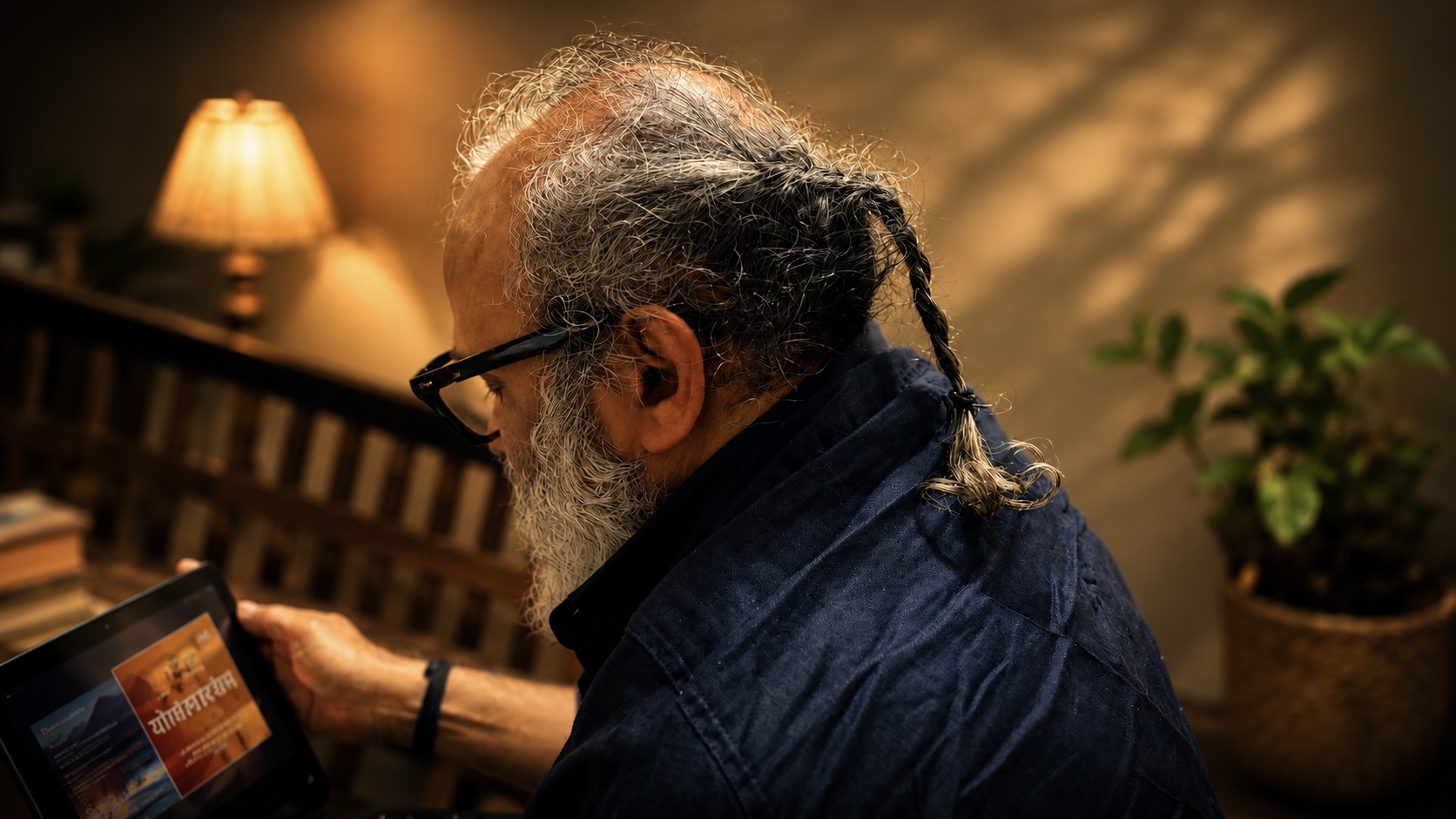
The Illusion of Witnessing Thoughts
1 month ago By Yogi AnoopThe Illusion of Witnessing Thoughts
“Watch your thoughts.”
Few instructions have become as fashionable in contemporary meditation as this one. Yet, after years of observation and inquiry, I have come to question whether such an instruction is truly possible—or at least whether it is as simple as it is often presented.
The difficulty lies in a subtle but profound distinction. Thinking is not something that merely happens in the way rain falls or wind blows. Thinking is an intentional act. A thought is not simply an event appearing before consciousness; it is an activity in which the mind itself becomes the participant. This difference between an event and an act is the source of much confusion surrounding the idea of witnessing.
The external world makes this distinction obvious. You can watch rain falling because you are not creating the rain. Clouds drift, leaves tremble, rivers flow—all of these unfold independently of your participation. You remain untouched by the event. Because you are not the doer, you can effortlessly become the witness.
Classical Sāṃkhya philosophy describes this beautifully. The Purusha—pure consciousness—is eternally the seer, never the actor. Nature performs its movements while consciousness simply illuminates them.
But something entirely different happens the moment thought begins. Thought does not merely register reality; it personalizes it. It takes an external event, gives it meaning, attaches memory to it, relates it to identity, and quietly whispers, “This concerns me.” At that instant, experience ceases to be merely observed—it becomes owned. The thinker and the process of thinking are no longer separate.
This is where the popular instruction, “Watch your thoughts,” encounters a philosophical paradox.If the one who is supposedly witnessing is simultaneously the very one engaged in thinking, then who exactly remains outside the process to observe it? The observer has already become the participant.
Consider an ordinary experience. Suppose you are making one of the most important decisions of your life. Every faculty of the mind becomes absorbed. One thought generates another. Possibilities branch into consequences, consequences into fears, fears into hopes. The mind is completely immersed in its own movement.
At that moment, are you genuinely observing the thought process? Or are you thinking?
In lived experience, there is rarely a separation. Observation requires stillness. Thinking demands participation. The two occupy fundamentally different modes of consciousness. The same truth becomes even clearer through something as simple as eating. Imagine tasting a perfectly prepared meal. The richness of flavor, the texture, the aroma—all are fully alive. When the experience is complete, there is no distance between you and the taste. You are not standing outside the experience observing it. You are immersed within it. To truly taste is to become one with tasting.
Only after the experience has passed can reflection begin. Sāṃkhya refers to liberation as Viveka—the discrimination between the Seer and the Seen. Freedom does not arise from creating an imaginary observer inside the mind; it arises when consciousness genuinely ceases to identify with the movements of nature.
Modern psychology speaks of observational distance, while neuroscience offers another perspective. During deep cognitive engagement, the brain reorganizes its activity around task-oriented networks, while the systems associated with detached self-referential awareness become significantly quieter. In such moments, the subjective experience of being a detached witness naturally disappears—not because awareness is absent, but because attention has become completely identified with the cognitive process itself.
This explains why witnessing external events feels effortless, whereas witnessing active thinking becomes profoundly difficult.
A bird can be watched because it belongs to the world. A thought cannot, because it appears as mythought. The sense of ownership is built into the very architecture of thinking. This insight has long been recognized by contemplative traditions. Genuine sages rarely claimed that one remains a witness during the full force of active thinking. Rather, they observed that witnessing becomes possible as thought subsides, as the turbulence of the mind loses its momentum.
One may perceive the beginning of a thought. One may notice its fading. One may recognize the tendency of the mind to initiate thinking. But while thought is fully alive—while the thinker and thinking are indistinguishable—the witness has already dissolved into the process. The moment separation is authentically experienced, thinking itself begins to fall silent.
This leads to a profound conclusion. Perhaps we never truly witness thoughts. What we witness is the space in which thoughts have ceased.
Not the movement of thinking—but the stillness that remains when the movement comes to an end.The witness does not stand beside thought. The witness appears only in the absence of thought.
— Yogi Anoop
Recent Blog
Copyright - by Yogi Anoop Academy