
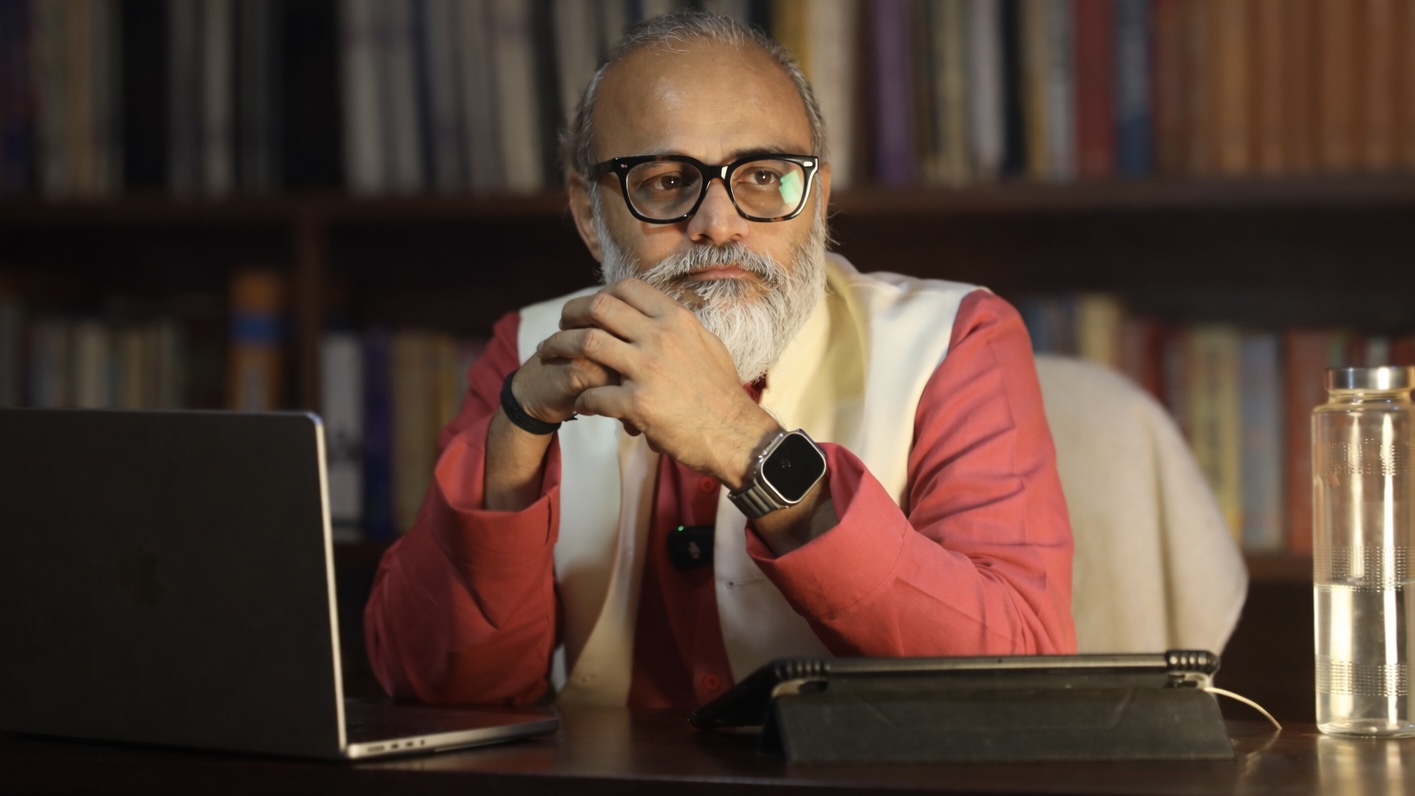
Listen… and do not speak
8 months ago By Yogi AnoopListen… and do not speak. Listen… but do not weave.
Most of human life is not spent in listening, but in weaving. The moment something occurs within—some vibration, some sensation, some subtle tremor—the mind immediately gives it words, assigns it meaning, and then begins to weave a story around it. This weaving gives the mind a sense of security, because stories create control. But where there is control, there is no awareness.
The listening this article speaks of is not a sound heard by the ears. It is a listening that experiences the subtle waves and vibrations arising within the brain without interfering with them. It is not sound itself, but the possibility of vibration—like a movement arising in the depths of the ocean, complete in itself even before it reaches the surface, or even if it never does.
The Upanishads do not call this śravaṇa (listening through the senses), but antar-śravaṇa—inner listening. The Katha Upanishad clearly states that truth can be grasped neither through speech nor through logic. From where speech arises, to that very point speech returns; from there awareness begins. This is why the Upanishads end in silence—because truth cannot be spoken, it can only be realized. Truth already exists; only its awareness happens.
From a scientific perspective as well, sound is not a solid entity. It is merely vibration—oscillations arising in air, in fluids, or within the nervous system. Neuroscience explains that the brain does not hear sound directly; it first converts vibrations into electrical signals, and then constructs meaning based on memory, conditioning, and past experience. In other words, what we hear is not actual sound, but an interpretation created by the mind.
It is here that Yogi Anoop’s argument enters:
“If you can pause before interpretation—if you know the art of stopping—awareness can occur.”
The moment interpretation begins, weaving begins. Good and bad, right and wrong, mine and yours—these are all threads of weaving. The Upanishads call this the construction of nāma-rūpa (name and form). As soon as name and form arise, experience becomes fragmented. Awareness is whole; it does not accept classification.
According to Yogi Anoop, the problem is not in sound, but in the listener. The mind does not allow listening, because listening threatens its very existence. The entire structure of the mind rests on weaving. That is why it immediately grasps every experience and turns it into a story. But awareness does not arise from stories. Awareness arises when the storyteller loosens his grip—when the story stops.
The amātra spoken of in the Mandukya Upanishad—where there is neither sound nor word—is not a philosophical imagination, but a direct experience. Yogi Anoop expresses it simply:
“Where the listener, while listening, hears nothing and sits still.”
When you become still—adding nothing, subtracting nothing—the fundamental nature of existence begins to be realized by itself. This nature is both outer and inner. When interference between the outer and the inner dissolves, awareness becomes indivisible. There remains neither seeker nor sought, neither listener nor speaker.
This is listening—
where there is no one to speak, no one to weave, and no words left to be spoken.
There the Upanishads fall silent, there science accepts its limits,
and there—darśana happens, where the seer makes the seen a means for realizing the Self.
Recent Blog
Copyright - by Yogi Anoop Academy