
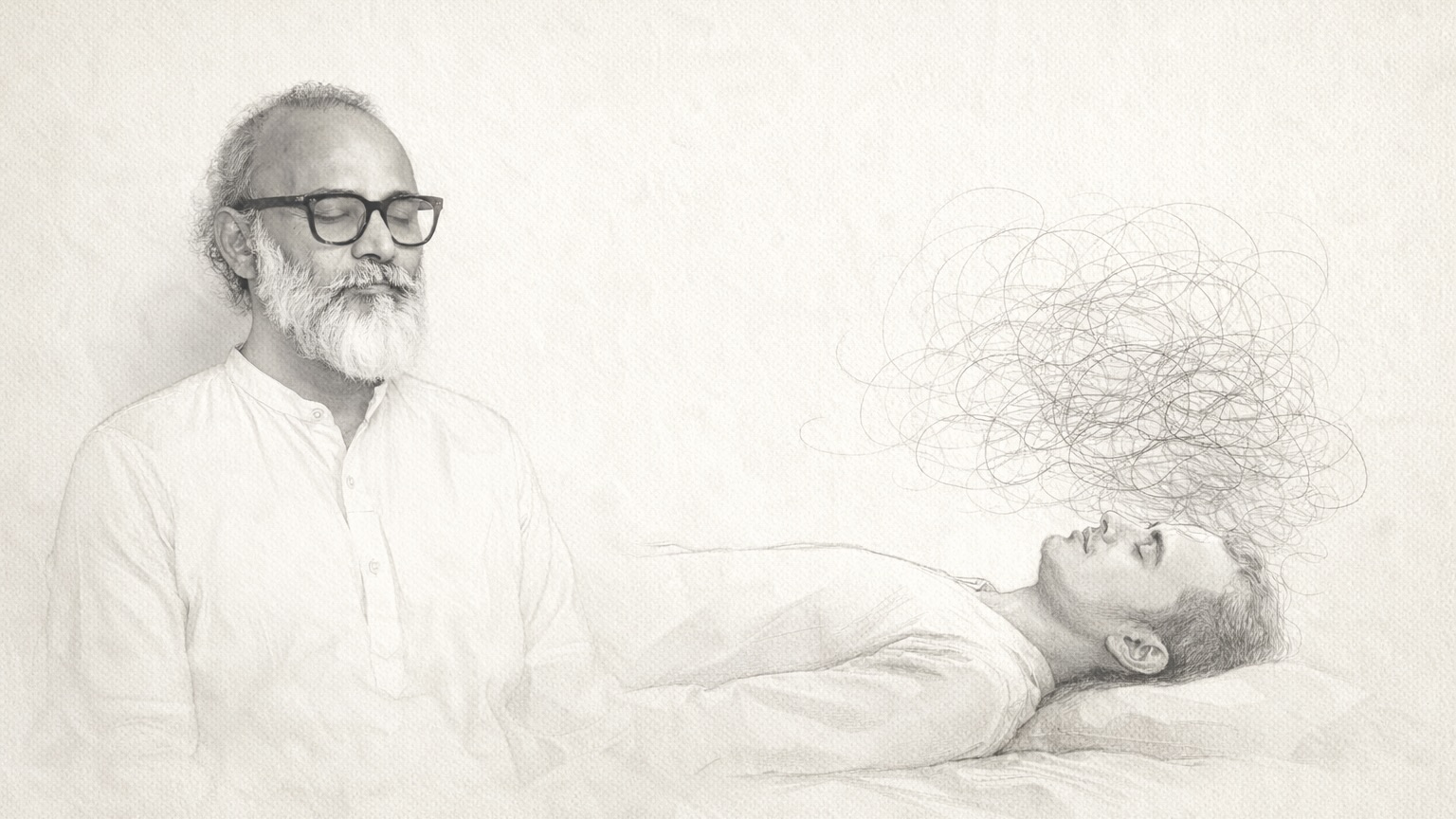
Illusion of The Rest
7 months ago By Yogi AnoopThe Illusion of Rest and the Restlessness of the Mind
It is a common assumption that when the body reclines, the mind too reclines with it. After the fatigue of the day, when the limbs grow still and outward engagements subside, we tend to conclude that silence has descended upon our entire being. Yet this conclusion arises from a superficial observation. The stillness of the body and the stillness of the mind are not synonymous events; they belong to different orders of experience.
The body functions through the organs of action. When the hands cease to move, the feet no longer wander, and speech withdraws into quietude, external activity undoubtedly diminishes. But the mind does not confine itself to these instruments of action. Its field is subtler and far more pervasive. It is woven into perception, memory, imagination, and the latent impressions accumulated across time. Therefore, when physical movement stops, only one dimension of human activity has paused. The inner theatre remains illuminated.
A philosophical question emerges: when the mind withdraws its attention from the organs of action, does it enter into genuine repose? In theory, one might suppose so. If it is no longer entangled in doing, should it not taste a certain freedom? Yet lived experience suggests otherwise. Often, the very moment the body becomes quiet, the mind intensifies its movement. It turns toward recollections, projections, unfinished conversations, imagined futures. Its activity does not diminish; it merely changes its object.
This reveals a crucial distinction. The mind does not withdraw from action because it longs for silence; it withdraws because it is fatigued by one mode of engagement. Exhaustion does not lead it to stillness but to substitution. It abandons external action only to immerse itself in internal narration. What appears to be rest is, in truth, a transference of motion—from the gross to the subtle, from muscular effort to cognitive proliferation. The outer noise fades, and the inner murmur becomes audible.
The mind has never been trained to remain unoccupied. It has been conditioned to flow from one object to another, from one concern to the next. Mistakenly, we have come to equate mind with movement itself. Thus, when it tires of one domain, it does not pause; it relocates. It seeks another foothold, another preoccupation. This perpetual migration offers a peculiar sense of security. For in stillness, the mind would have to encounter itself without distraction. Movement shields it from that confrontation.
Hence, after leaving one thought, it quickly clings to another. The chain of displacement continues unbroken. When attention shifts from the organs of action to the organs of perception and the inner faculties, thought may even become subtler and more penetrating. With the reduction of external stimuli, the internal voice grows clearer. In such moments, mental formations can exert profound influence upon the brain and the emotional structure. It is perhaps for this reason that the ordinary mind resists complete inactivity. If it cannot act, it will imagine. If it cannot speak, it will remember. Activity at some level must persist.
From this perspective, it becomes evident that bodily rest does not guarantee mental peace. Authentic rest cannot be reduced to inactivity, nor can it be discovered in perpetual redirection. True repose begins when the mind recognizes its own habit of displacement and relinquishes the compulsion to seek a new object each time it abandons an old one.
Real rest is not found in external withdrawal alone, nor in moving from here to there and then elsewhere again. It arises when the mind releases an object and remains with the aftertaste of that release—when it experiences the space that follows relinquishment rather than rushing to occupy that space with another pursuit. In that unoccupied interval, where no new attachment is sought, a different quality of stillness becomes possible. Not the stillness of exhaustion, nor the quiet of substitution, but the lucid stillness of awareness unentangled.
Only there does rest cease to be an illusion.
Recent Blog
Copyright - by Yogi Anoop Academy