How to Conquer the Breath
8 months ago By Yogi AnoopHow to Conquer the Breath — A Philosophical Perspective
In the science of pranayama, the idea of “conquering the breath” sounds deeply attractive, yet it is one of the most misunderstood concepts. It is commonly interpreted as a physical victory—as if the breath must be suppressed, forcibly retained, or brought under control through technique. However, this understanding is incomplete and fundamentally misleading. Any attempt to dominate the breath is still a subtle insistence on being the doer. The sense of “I am doing” remains intact, and wherever doership exists, victory can only be illusory, never real.
The true meaning of conquering the breath does not lie in gaining authority over it, but in realizing its inherently involuntary nature. The breath comes on its own and leaves on its own. From birth to death, it continues without seeking permission, without responding to personal will. When one deeply realizes that breathing is not governed by desire or command, but by the intrinsic order of nature itself, this understanding no longer remains limited to inhalation and exhalation alone. Through the breath, one begins to perceive the whole of nature—the continuous movement of the five elements, flowing effortlessly, without effort, without a doer.
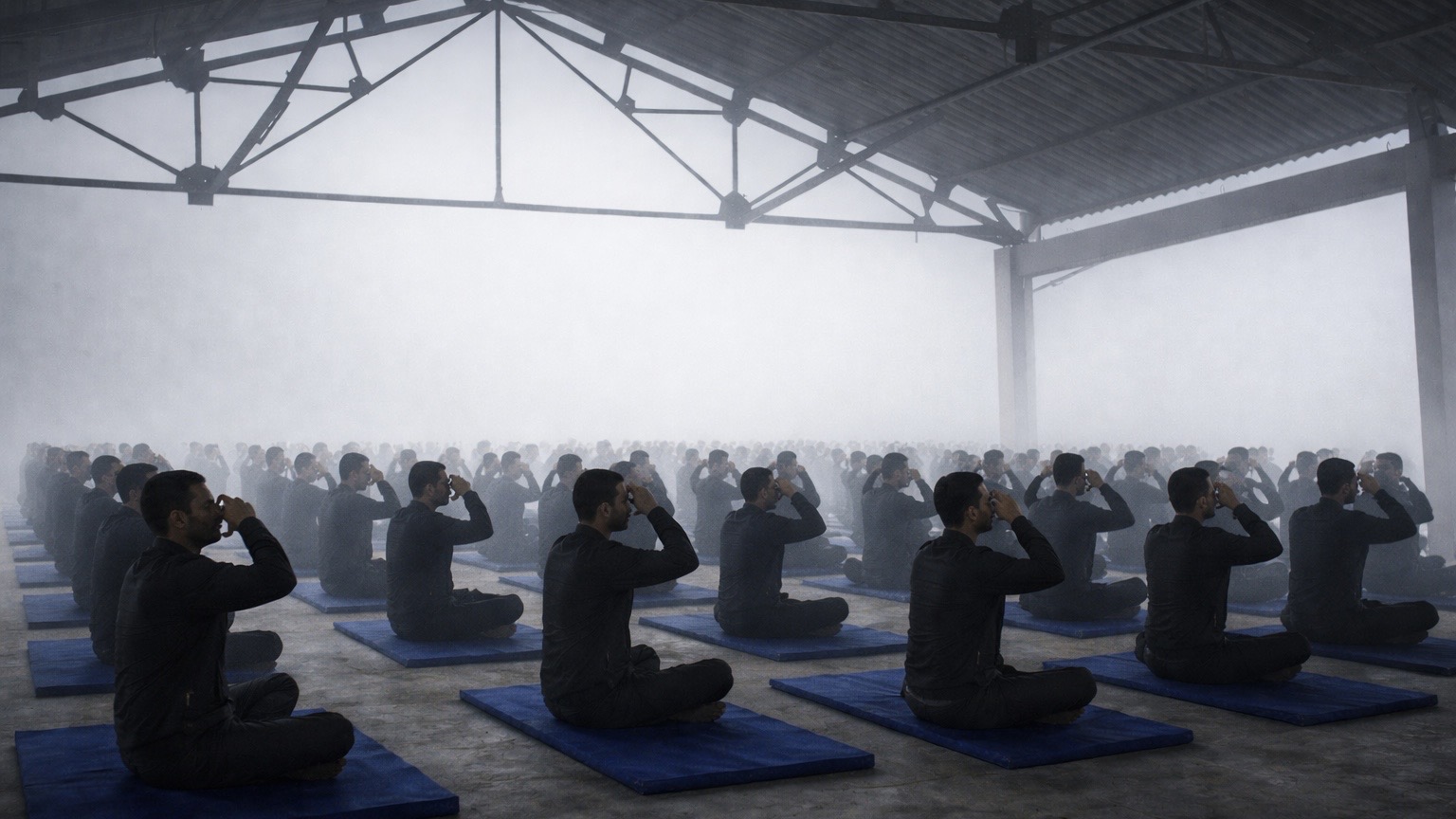
Pranayama does not stop this involuntary movement. It simply cultivates the capacity to observe. It reveals a crucial truth: that which is truly still had mistakenly assumed itself to be in motion. Just as a person standing by a river may feel, after watching the flowing water for a long time, that they themselves are moving—the head may momentarily spin, giving the illusion of inner motion—but the moment the gaze shifts, clarity returns: the movement was in the river, not in the observer. The same phenomenon unfolds with the breath. By witnessing the movement of breathing, one begins to realize, “I am not the movement; I am the witness of the movement.”
From this realization arises what is mistakenly called the conquest of the breath. The breath no longer disturbs the inner stability. Whether it becomes fast or slow, deep or shallow, no inner tremor is produced. At the same time, it becomes evident that “I” am not attempting to alter the nature of the breath either. The breath continues to do what it has always done; the only difference is that the struggle with it has ended.
This state has often been symbolically described as having tamed a lion. The lion is not killed, nor is its strength taken away; only its threat disappears. Its presence no longer generates fear. It remains powerful, fully alive, yet no longer a source of suffering. The breath is exactly the same—powerful, natural, uncontrollable by force, yet now fear-free.
Therefore, in pranayama, the victory is not over the breath. The breath remains as it is—coming and going, moving and pausing. The true victory belongs to the one who is freed from doership and rests in the experience of non-doership. That alone is real conquest. For such a one, neither breath binds nor movement disturbs. From this point onward, pranayama ceases to be merely a bodily practice and becomes a profound contemplation of existence itself.
Recent Blog
Copyright - by Yogi Anoop Academy