How Gas Truly Leaves the Body
3 months ago By Yogi AnoopThe Silent Grip Within: How Gas Truly Leaves the Body
We often assume that something as simple as gas passing from the stomach is merely a physical process. But if you observe deeply, it reveals a far subtler truth about the human system—one that is not rooted in the body alone, but in the silent habits of the mind.
I have often said: gas cannot leave the abdomen unless the abdominal muscles are relaxed. But those muscles do not relax on their own. They remain held, subtly contracted, as long as the mind continues to hold them. And the mind does not release this grip until a certain understanding dawns—that it is the one creating the tension in the first place.
This realization is not immediate. It may take months, sometimes years, for a person to perceive that they themselves are holding their abdomen and internal organs in a constant, unconscious contraction. This grip is so refined, so deeply normalized, that it begins to feel like a natural state. Yet in truth, it becomes the root of many disturbances.
When this internal pulling persists, it does not merely trap gas—it disrupts the entire rhythm of digestion. The diaphragm loses its natural movement, the intestines slow in their wave-like motion, and a subtle pressure builds within. This pressure is not only physical; it carries a psychological weight—as if something inside is being constantly held, restrained.
Breathing no longer feels free. There is a faint obstruction, not always visible, but deeply felt. The forehead may seem tight, the head slightly burdened, as though the body is quietly resisting itself.
Without understanding this inner contraction, no external remedy can offer lasting relief. Because the issue does not lie merely in the muscles—it lies in a subtle mental tendency, a habit of holding on.
And so, the solution does not begin with action, but with awareness.
A moment comes when one begins to sense: “It is I who is holding this.”
This recognition is not intellectual—it is experiential. And it is not easy. To truly see that “I am the one creating this grip” is a deep inner practice in itself. Only after this realization can the process of letting go truly begin.
When this awareness arises, even slightly, a shift becomes possible. The same mind that was holding can now begin to release.
One of the simplest doorways into this release is through breath—not as a technique, but as a means to reconnect with inner looseness.
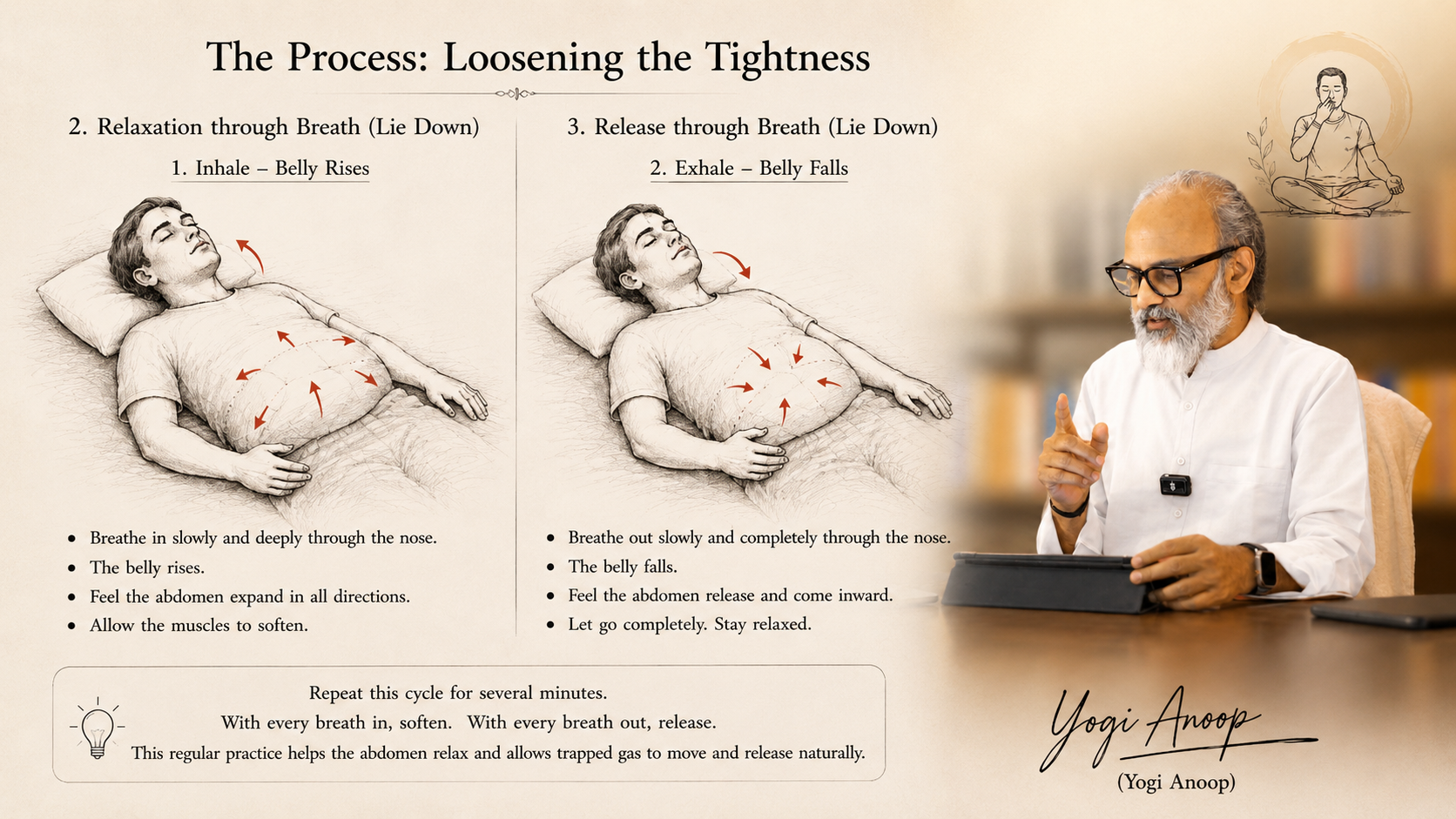
Traditionally, pranayama is practiced in a seated posture. But through exploration, it has been found that lying down allows a more direct perception of abdominal tension. In this position, the sense of “doing” reduces, and the sense of “feeling” becomes clearer.
The process unfolds in two gentle phases.
First, lying on your back, you allow the breath to enter slowly through the nose. There is no force, no control. The attention rests softly on the abdomen. As the breath flows in, the belly rises naturally—like a balloon being filled, not by effort, but by allowance. You begin to feel the abdomen expanding in all directions—upward, downward, sideways. The body is not being manipulated; it is being observed.
Then comes the second phase—exhalation.
Here, something subtle shifts. The breath is not pushed out. It simply leaves. And in this effortless leaving, the abdomen begins to soften on its own. Because there is no attempt to control the outgoing breath, the muscles lose their habitual grip. A natural loosening begins to appear.
This softness is not created—it is revealed.
And within this softness, there is rest.
If this simple cycle is continued for about eleven minutes, something profound begins to unfold. With each inhalation, there is a gentle opening. With each exhalation, a deeper release. Gradually, both body and mind begin to soften together.
Over time, the abdominal tightness reduces. Digestion starts to regain its rhythm. And the gas that once felt trapped begins to move freely—not through force, but through the absence of resistance.
This is not merely a breathing exercise. It is a quiet process of recognizing and dissolving an invisible inner grip.
True healing, in this sense, does not come from doing more—but from holding less.
It is not the body that needs to be fixed, but the unconscious effort that needs to be seen.
And when that effort is seen clearly, it begins to dissolve—naturally, silently, and completely.
Recent Blog
Copyright - by Yogi Anoop Academy