
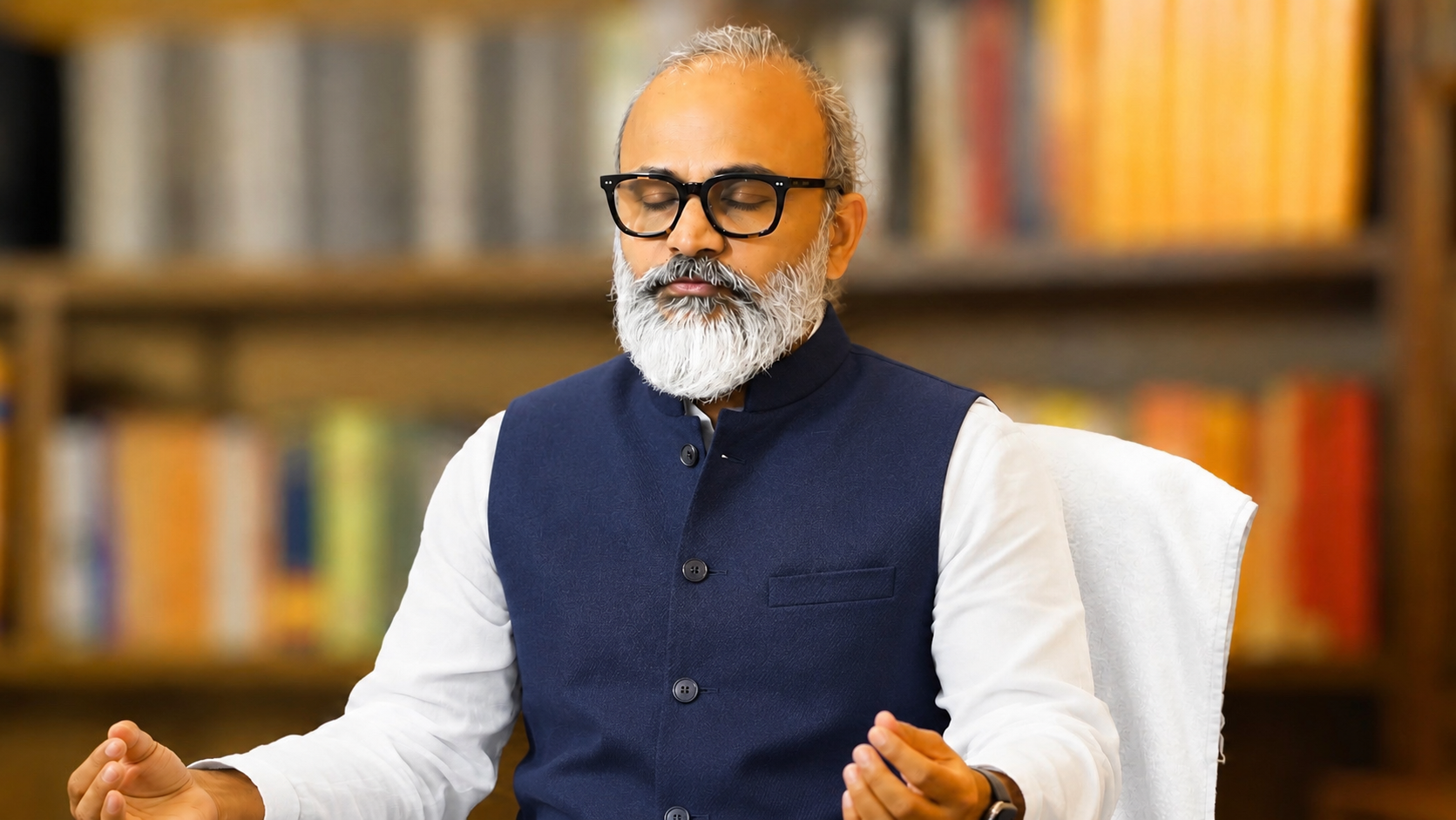
Disease Begins in an Unripe Mind
3 months ago By Yogi AnoopThe Immaturity of Mind as the Seed of Disease
Disease does not merely arise from the body—it deepens where the mind remains unripe.
There exists a subtle yet profound distinction between the maturity of the body and the maturity of the mind. The body ages inevitably, moving forward in time with biological precision. But the mind does not necessarily follow this progression. It can remain suspended, even regressing, trapped in its own unfinished tendencies.
If you observe a child, you will notice that most of their joy does not come from reality, but from imagination. A child lives almost entirely in a self-created world—dreaming of becoming something grand, experiencing pleasure through anticipation alone. A mere thought—of flying an aircraft, owning something luxurious—is enough to generate happiness. The body’s needs are secondary; imagination itself becomes nourishment.
The difficulty begins when the body continues to age, but the mind refuses to evolve beyond this imaginative dependence. Instead of maturing into clarity, it often sinks deeper into fantasy. Sometimes this even takes a spiritual disguise—where one begins to believe that unseen forces will take care of everything. Yet this too is only another layer of psychological projection. The mind remains in illusion, only now clothed in sacred language.
Here, imbalance is born.
The body advances toward completion of its life cycle, yet the mind moves in the opposite direction—toward dependency, impulsiveness, and immaturity. There is a growing dissonance: the body becomes older, but the mind becomes younger in its demands.
This is visible even in one’s relationship with food. A mature body no longer requires instant energy, yet the mind continues to crave it—sugar, stimulation, quick satisfaction. These were appropriate in childhood, when the body demanded immediate fuel. But when the same tendencies persist into later life, it reveals that the mind has not matured alongside the body.
A mature mind naturally aligns its choices with the needs of the body. It does not chase intensity; it seeks appropriateness. This alignment was deeply understood in traditional systems, where even ordinary individuals often ate only once a day—not merely for physical health, but to refine the mind. When the entire system is not constantly occupied with digestion and consumption, a different quality of awareness becomes possible.
If the mind remains perpetually engaged in seeking pleasure—especially through food and stimulation—it never gathers the space required for its own evolution. Disease, then, is not accidental; it is a consequence of misdirected energy.
To say that the mind is aging does not mean it is becoming heavier—it means it is becoming deeper. Its patience increases. Its perception widens. It begins to see multiple dimensions of a situation rather than reacting from a narrow viewpoint. When the mind is immature, it reacts quickly and sees very little. When it matures, its reactions diminish because its understanding expands.
One subtle sign of this maturity is the capacity to experience fully. Even something as simple as taste becomes deeper. In earlier times, people would eat with their eyes closed—not as a ritual, but as a natural expression of total involvement. In that moment, the senses withdraw from distraction and converge into experience. This is depth.
In contrast, a restless mind—like that of a child—creates noise even while consuming. It cannot listen, neither to others nor to itself. The same applies internally: if the mind is full of noise, it loses its ability to perceive truth.
Therefore, as the body matures, the mind must also evolve in parallel. Without this, there is fragmentation.
Spiritual practice, in its truest sense, is not about adopting beliefs—it is about training the mind according to the stage of life. In childhood, energy is outward and competitive. One seeks validation, comparison, victory. But as maturity arises, the direction must turn inward. Action is no longer to prove something to others, but to understand oneself.
When this shift happens, concentration becomes effortless. There is no tension in it, because there is no audience. One is not trying to achieve—only to observe. And in that observation, the depth of the mind increases rapidly.
To keep the mind “young” does not mean to keep it childish. It means to keep it growing. A truly youthful mind is one whose observation is expanding, whose understanding is refining. The body may reach a point where its growth stops—but the mind has no such limitation. Its maturity can deepen endlessly.
And finally, one must understand this clearly: disease is not merely the result of wrong food. More often, it is the result of an immature mind—because it is the immature mind that continuously chooses what is harmful.
The correction, therefore, does not begin with the body.
It begins with the evolution of the mind.
Recent Blog
Copyright - by Yogi Anoop Academy